Get in your inbox the latest News and Offers from
- REPEN Complex Syokimau - Katani Rd, Nairobi

- Office Time:
- Monday to Friday 8:00am - 5:00pm, Saturday 8:00am - 2:00pm
- Call Us:
- +254 701194859
- Email:
- info@lorex.co.ke
Workplace Fire Safety in Kenya
Workplace Fire Safety in Kenya
LOREX ENTERPRISES LIMITED
Workplace Fire Safety in Kenya
Fire safety starts before there is smoke
A workplace fire can develop in seconds, but the conditions that allow it to happen often build up slowly. An overloaded extension lead, combustible waste beside a heat source, a locked emergency exit or an extinguisher hidden behind stored materials may appear to be small issues. When combined, they can turn an ordinary working day into a serious emergency.
Effective fire safety is therefore not limited to buying extinguishers. It is a management system that brings together prevention, early warning, safe escape, trained people, maintained equipment and clear responsibilities. The goal is to stop fires from starting, limit their growth if they do start and ensure that everyone can reach safety without confusion.
This guide is written for employers, property managers, contractors, institutions and workplace safety teams in Kenya. It explains the practical controls that should be considered in offices, shops, warehouses, workshops, construction sites and other workplaces. Every facility is different, so the final arrangements should follow a site-specific fire risk assessment and advice from competent professionals.
The Kenyan legal foundation for workplace fire safety
Kenya?s Occupational Safety and Health Act, 2007 establishes duties relating to the safety, health and welfare of people at work. The Factories and Other Places of Work Fire Risk Reduction Rules, 2007 provide more specific workplace fire requirements. They address issues such as flammable substances, housekeeping, electrical equipment, escape routes, fire teams, training, drills, detection, firefighting appliances, written policy and fire safety audits.
Among the practical requirements, the Rules call for a written fire safety policy, suitable means of warning people, unobstructed and marked escape routes, a workplace assembly point and a firefighting team. They require fire drills at least once in every twelve months, with records kept. They also require a fire safety audit at least once every twelve months by an approved fire safety auditor. Fire detection and firefighting equipment must be maintained and inspected as required.
Compliance should not be reduced to an annual inspection. The Rules also require the occupier to monitor the workplace for possible fire risks and mitigate them. County fire and building requirements may additionally apply depending on the premises and location. Organisations should confirm the current requirements that apply to their particular operation and retain evidence of inspections, training, maintenance, drills and corrective actions.
Understand how a fire begins and spreads
A fire needs heat, fuel and oxygen. Removing any one of these elements can prevent ignition or stop combustion. In a workplace, heat may come from electrical faults, welding, cooking equipment, machinery, smoking materials or hot surfaces. Fuel may include paper, packaging, timber, fabric, plastics, gases, fuels, paints, solvents or accumulated waste. Oxygen is normally present in the air and may be enriched by certain industrial processes.
The practical lesson is that fire prevention must control both ignition sources and combustible materials. A good inspection does not merely count extinguishers. It looks at where heat and fuel could meet, how quickly a fire could spread, who might be exposed and whether smoke could block the escape route before people leave.
Begin with a site-specific fire risk assessment
A fire risk assessment should reflect the actual work being performed, the layout of the premises and the people who use it. A copied checklist can help prompt questions, but it cannot replace walking through the facility, observing work and speaking with employees. The assessment should be reviewed when the layout, equipment, stock, staffing or processes change, and after any fire, near miss or drill that reveals a weakness.
A practical assessment should identify ignition sources, fuels and people at risk; evaluate existing prevention and protection measures; determine whether escape arrangements are suitable; and set out actions, owners and completion dates. Particular attention is needed for visitors, contractors, night-shift workers, people working alone and anyone who may need assistance during evacuation.
The assessment should lead to decisions. If combustible stock narrows a gangway, the action is to restore and maintain the required access. If employees cannot hear the alarm in a noisy area, the warning system needs review. If a mezzanine has only one practical route down, the adequacy of escape requires competent technical evaluation. Recording a hazard without correcting it does not reduce the risk.
Control common workplace ignition sources
Electrical systems and equipment
Damaged cables, overloaded sockets, improvised connections, overheating equipment and poorly maintained installations are common warning signs. Electrical work should be carried out by competent persons, and defects should be reported and isolated promptly. Portable appliances, distribution boards and extension lead should be inspected according to risk and manufacturer guidance. Airflow around equipment should not be blocked, and high-load appliances should not be added to a circuit without confirming that it is suitable.
Charging areas deserve attention because batteries and chargers can generate heat, particularly when equipment is damaged or incompatible. Keep charging locations clear of combustible storage, use the correct charger and follow the manufacturer?s instructions. Employees should know that a warm smell, repeated tripping, sparks, discoloration or unusual heat requires action, not repeated resetting.
Hot work and heat producing activities
Welding, grinding, cutting, roofing torches and other hot work can send sparks beyond the immediate work area. Where these activities are not performed in a permanently controlled location, use an appropriate hot-work permit system. Remove or protect combustibles, check hidden spaces, provide suitable firefighting equipment and maintain a fire watch for the period determined by the risk assessment. Contractors must be included in the same controls as employees.
Smoking cooking and open flames
Smoking and open flames should be prohibited wherever flammable or highly combustible materials are manufactured, handled or stored. Designated arrangements must not endanger the workplace. Kitchens and tea points need good housekeeping, suitable electrical connections and clear rules for switching off appliances. Cooking equipment should never be left unattended, and grease accumulation should be controlled.
Manage fuels waste and storage
Good housekeeping is one of the most reliable fire controls. Waste, offcuts, packaging and dust can increase the fire load, obstruct exits and help flames spread. Remove waste regularly, keep gangways clear and prevent stock from covering alarms, detectors, sprinklers, extinguishers or electrical panels. Storage heights and aisle widths should be defined and monitored rather than left to convenience.
Flammable substances require suitable containers, clear identification, controlled quantities and appropriate storage. Review safety data sheets and separate incompatible materials. Spills and leaks should be contained and made safe without delay. Oil-soaked or contaminated rags may need covered metal receptacles because some materials can generate heat and ignite. The storage location must not threaten a means of escape.
Construction sites require the same discipline. Temporary power, fuel storage, gas cylinders, timber, packaging and hot work can change location as the project advances. Fire arrangements should therefore be reviewed by phase, communicated during induction and coordinated among contractors.
Keep every escape route usable
During a fire, smoke can reduce visibility and make familiar spaces difficult to navigate. Escape routes should be simple, clearly marked, adequately lit and kept free of obstruction. Exit doors, gangways, stairs and final exits must not be locked or blocked while people are present. Evacuation maps should match the current layout and show routes, exits and the assembly point.
A workplace should not rely on the ordinary entrance alone where the risk and layout require another safe exit. The Fire Risk Reduction Rules contain specific requirements for emergency exits, including location, marking and minimum dimensions. Any change to partitions, security doors, shelving or equipment should be checked to ensure it has not reduced escape capacity or created a dead end.
Security and fire safety must be coordinated. A door that prevents theft but delays evacuation creates a different danger. Access-control systems should fail safely where required, and employees should be able to leave without searching for a key. The route should continue to a place of safety; an exit that opens into a locked yard or hazardous area is not a complete escape solution.
Provide warning systems people can recognise
People need to know about a fire early enough to leave safely. The warning method must suit the size, layout, noise level and occupancy of the workplace. A small single-room premises may require a different system from a warehouse, multistorey office or industrial facility. The signal should be audible or otherwise perceptible throughout occupied areas, including washrooms, isolated rooms and noisy work zones.
Employees should recognise the alarm and understand that it means immediate evacuation. Visual warning devices may be necessary where noise is high or where occupants may not hear an audible alarm. Detection and alarm systems should be tested and maintained, defects recorded and corrective action followed through. Temporary impairment of an alarm or detector requires a controlled alternative arrangement, not silence.
Choose and maintain the right firefighting equipment
Fire extinguishers are selected according to the anticipated fire hazards, not by colour or price alone. Water, foam, dry powder, carbon dioxide and specialised agents have different uses and limitations. Using the wrong agent can spread burning liquid, damage equipment or expose the user to electrical danger. A competent assessment should determine the type, rating, number and distribution of appliances required.
Equipment should be conspicuously marked, accessible and protected from damage. It should not be used as a coat stand or concealed by stock. The Fire Risk Reduction Rules require firefighting appliances to be properly maintained and inspected and tested by a competent person at least once every twelve months, with records kept. Cylinders also require periodic examination and testing under the Rules.
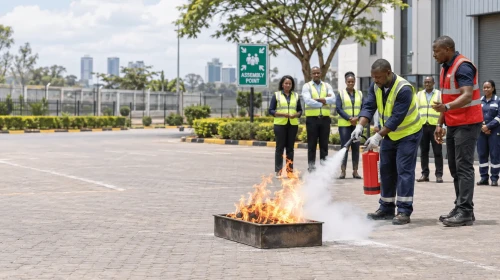
An extinguisher is not a substitute for evacuation. Only a trained person should consider using one, and only where the fire is small, the correct appliance is available, the alarm has been raised and a safe escape route remains behind the user. If smoke is increasing, the fire is spreading or there is uncertainty, the priority is to leave, close doors where safe and call the emergency services.
Build a trained workplace fire team
The Fire Risk Reduction Rules require each occupier to establish a firefighting team. The minimum team size under the Rules is at least two people where there are no more than ten workers, at least three where there are eleven to twenty-five workers, and at least five where there are more than twenty-five workers. Staffing patterns should also be considered so that trained coverage exists across shifts, departments, leave periods and remote work areas.
Team members need more than names on a noticeboard. Their functions include inspecting for fire risks, checking that fire protection facilities are maintained, conducting drills, helping train other workers, coordinating evacuation and recommending corrective measures after an incident. Members should receive the required basic fire safety training within the prescribed period after appointment.
All workers also need instruction appropriate to their role. At a minimum, they should know how to raise the alarm, where to evacuate, which route to use, where to assemble, who may assist others and why nobody should return for personal belongings. Selected employees may require additional training in extinguisher use, shutdown procedures, roll calls, first aid and incident coordination.
Use drills to test the plan
A drill is a practical test, not a ceremonial walk to the car park. It should test whether the alarm is noticed, routes remain available, people move safely, visitors and contractors are accounted for and the assembly process works. Observers should record the time and any problems without encouraging unsafe rushing.
After the drill, review what happened. Did anyone use the wrong exit? Was a door difficult to open? Could a person working in a remote room hear the alarm? Did supervisors know who was missing? Was the assembly point placed away from emergency access? Corrective actions should be assigned and closed. Keep the drill record and repeat the exercise when significant weaknesses require confirmation.
The Rules require a drill at least once every twelve months. Higher-risk workplaces, changing construction sites or organisations with frequent staff turnover may decide that more frequent exercises are necessary. Drills should include different shifts where applicable and should be planned sensitively for people whose health or mobility may be affected.
Plan for people who may need assistance
A general announcement to ?use the stairs? is not a complete plan for everyone. The workplace should identify, confidentially and respectfully, anyone who may need help because of mobility, hearing, vision, health, pregnancy, unfamiliarity with the building or another factor. Visitors may also need guidance. Personal or role-based evacuation arrangements should be developed with the people concerned rather than making assumptions about what they can do.
Evacuation chairs, refuge arrangements, buddy systems or other measures may be appropriate depending on the building and professional assessment. Equipment is only useful if it is available, maintained and supported by trained people. The plan should remain workable when the usual assistant is absent.
What employees should do when fire is discovered
Raise the alarm immediately using the workplace procedure. Warn people in the immediate area without putting yourself at risk. Leave by the nearest safe route, close doors behind you where this can be done safely and go directly to the assembly point. Do not use a lift unless the building?s emergency plan specifically permits an evacuation lift. Do not stop to collect belongings and do not re-enter until the responsible emergency authority confirms that it is safe.
Call the emergency services using the contact arrangements established for the site. Provide the location, nature of the emergency and any known information about people at risk or hazardous materials. The designated coordinator should account for workers, visitors and contractors and pass relevant information to responders. Nobody should be sent back into the building to search.
If clothing catches fire, the person should stop, drop and roll, while others use appropriate assistance without putting themselves in danger. Burns require prompt first aid and medical evaluation. Do not apply ice, butter, toothpaste or other household substances to a burn. Workplace first aid arrangements should be integrated into the emergency plan.
Keep records and complete the annual fire safety audit
Useful fire safety records include the current risk assessment, policy, inspection findings, equipment service reports, alarm tests, training records, fire-team appointments, drill reports, evacuation plans and evidence that corrective actions were closed. Records help managers track recurring gaps and demonstrate that controls are active rather than merely promised.
Under the Fire Risk Reduction Rules, the occupier must arrange a fire safety audit at least once every twelve months by an approved fire safety auditor. The audit should examine the workplace arrangements and lead to clear corrective action. It does not replace day-to-day inspections or management responsibility. A site can pass an annual visit and become unsafe the following week if an exit is blocked or equipment is moved.
The Rules also set reporting duties when a fire occurs at the workplace, including notification to the nearest occupational safety and health area office within twenty-four hours and a written report within the prescribed period. Organisations should verify and follow the current reporting process and also investigate the causes, contributing factors and response so that lessons are applied.
A practical fire safety improvement plan
Timeframe Priority actions Evidence to retain
Immediately Clear exits and firefighting points, remove obvious ignition hazards, confirm alarm and emergency contacts. Inspection record and photographs
Within 30 days Complete or review the fire risk assessment, policy, evacuation plan, fire-team appointments and training needs. Approved documents and action tracker
Within 60 days Service deficient equipment, improve signs and detection, conduct training and close priority actions. Certificates, attendance and closure records
Within 90 days Conduct and review a drill, test accountability arrangements and update the plan. Drill report and corrective actions
Ongoing Inspect routinely, manage change, maintain equipment and arrange the required annual audit. Inspection, maintenance and audit records
Questions managers often ask
Is buying extinguishers enough
No. Extinguishers address only one part of the problem. A workplace also needs prevention, safe storage, warning, escape routes, trained people, drills, maintenance, policy, records and periodic audit. The correct equipment must be selected for the actual hazards.
How often should a workplace conduct a fire drill
The Fire Risk Reduction Rules require at least one drill in every twelve-month period and a record of the drill. A risk assessment may justify more frequent drills, particularly where the workplace, staffing or processes change regularly.
Who should carry out the annual fire safety audit
The Rules require the audit to be performed by an approved fire safety auditor. The organisation should verify the auditor?s current approval and keep the audit report together with evidence that corrective actions have been addressed.
Can employees fight a fire
Evacuation and life safety come first. Only trained people should consider first-aid firefighting, using the correct appliance on a small fire and only when they retain a safe escape route. Nobody should delay escape or take personal risks to protect property.
How Lorex Enterprises can support your workplace
Lorex Enterprises Limited provides HSE consultancy and training alongside construction, civil engineering and project-management services. This combination supports organisations that need to integrate fire prevention, emergency planning and safe operations into their buildings, projects and workplaces.
Lorex can support clients with fire safety awareness, fire-team training, workplace risk reviews, emergency planning and related HSE advisory services, subject to confirming the scope and any approvals required for the assignment. Contact the team to discuss your workplace, project stage and current fire safety priorities.
Talk to Lorex: www.lorex.co.ke | +254 701 194 859 | info@lorex.co.ke
References
Occupational Safety and Health Act 2007 Kenya Law
? Fire Risk Reduction Rules 2007
? Directorate of Occupational Safety and Health Services